GoPro vs DJI vs Insta360: Which Action Camera Is Best for Motovlogging in 2027?
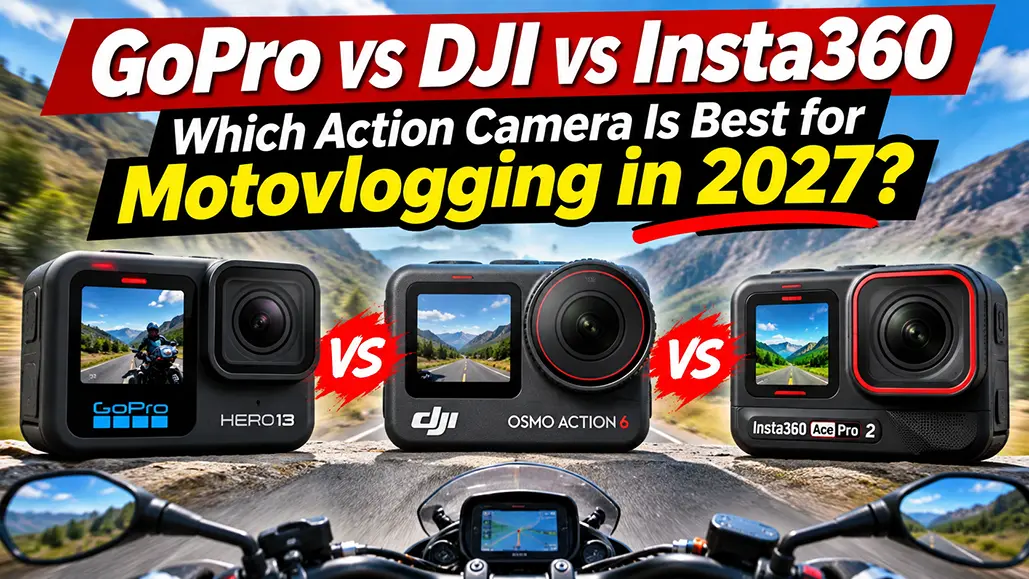
Choosing the right action camera can make an enormous difference to your motorcycle videos. But with GoPro, DJI and Insta360 offering increasingly sophisticated technology, which brand delivers the best combination of image quality, stabilisation, audio recording and everyday practicality for motovloggers?
For motorcyclists looking to record their adventures, the action camera has become almost as essential as the helmet-mounted microphone. Whether capturing a weekend ride through the countryside, producing a motorcycle review or documenting a European touring adventure, today’s compact cameras offer capabilities that would once have required considerably larger and more expensive equipment.
Three manufacturers dominate much of the conversation: GoPro, DJI and Insta360.
Each has developed a distinct approach to capturing action footage. GoPro helped establish the modern action camera market, DJI has increasingly challenged conventional expectations with its Osmo Action range, while Insta360 has introduced new creative possibilities through 360-degree recording and advanced reframing tools.
However, choosing the best camera for motovlogging is not simply a question of resolution or technical specifications.
Motorcycle filming presents challenges that ordinary action camera comparisons often overlook. Wind noise, helmet mounting, vibration, battery life, changing light conditions and the practicalities of operating equipment while wearing gloves all influence the experience.
For MotoVlogger, we examine the strengths and limitations of all three manufacturers, with particular attention to what matters on a motorcycle.

GoPro HERO13 Black
£288.73
Amazon.co.uk
GoPro HERO13 Black
GoPro: The Established Action Camera Specialist
5.3K/60fps · HyperSmooth stabilisation · HB-Series lens accessories
A versatile choice for traditional helmet-mounted filming, with a mature accessory ecosystem.
GoPro remains one of the most recognisable names in action cameras, and its HERO range has long been associated with helmet-mounted filming.
The HERO13 Black offers 5.3K recording at 60 frames per second, 4K at up to 120fps and GoPro’s HyperSmooth stabilisation. Its interchangeable HB-Series lens accessories add further flexibility, particularly for riders wanting wider perspectives or more cinematic footage.
For motovloggers, the principal attraction is the combination of reliable image stabilisation, straightforward operation and a substantial selection of mounting accessories.
GoPro also offers useful GPS-related recording capabilities, allowing riders to incorporate journey information into their content.
However, external audio can require additional accessories, depending on the microphone being used. That increases the overall cost and complexity of a helmet-mounted setup.
There is also an important development for 2027 buyers. GoPro introduced its MISSION 1 range in 2026, including the MISSION 1 PRO, which offers 8K/60fps recording and a larger 1-inch-class sensor. These cameras extend GoPro’s options beyond the familiar HERO range, although their additional capabilities and higher prices will not necessarily benefit everyday motovloggers.
MotoVlogger’s assessment: GoPro remains particularly attractive to creators who value established mounting solutions, flexible accessories and conventional action-camera filming.

DJI Osmo Action 6
£319.00
Amazon.co.uk
DJI Osmo Action 6
DJI: A Strong Contender for Everyday Motovlogging
1/1.1-inch sensor · 8K/30fps · OsmoAudio microphone connectivity
Particularly appealing to riders who want a compact camera and a simpler wireless audio workflow.
DJI has become an increasingly serious competitor in the action camera market.
The Osmo Action 6 combines a 1/1.1-inch sensor with a variable f/2.0–f/4.0 aperture, 8K recording at up to 30fps and DJI’s RockSteady stabilisation technology.
For riders filming across changing lighting conditions, from bright country roads to shaded woodland routes, the sensor and aperture arrangement provide useful flexibility.
One of DJI’s most interesting advantages is its OsmoAudio ecosystem.
Compatible DJI wireless microphones can connect directly to the camera without requiring a conventional external microphone receiver. For motovloggers, this can simplify equipment installation and reduce the number of cables or accessories involved.
However, helmet microphone placement and wind protection remain essential. Wireless connectivity alone cannot eliminate turbulence around a motorcycle helmet.
Battery life is another consideration. DJI advertises up to four hours of operation under specified 1080p recording conditions, although higher resolutions, cold weather and different settings can substantially reduce real-world endurance.
The camera also offers approximately 50GB of usable internal storage, providing a useful fallback if a memory card is forgotten.
MotoVlogger’s assessment: The Osmo Action 6 makes a compelling case as an everyday motovlogging camera, especially where simple audio connectivity, compact dimensions and changing light conditions are priorities.

Insta360 Ace Pro 2 Motorcycle Bundle
£493.00
Amazon.co.uk
Insta360 Ace Pro 2 Motorcycle Bundle
Insta360: Creativity, Flexibility and New Perspectives
8K recording · 1/1.3-inch sensor · Bluetooth headset compatibility
A particularly interesting option for riders who already use compatible motorcycle communication systems.
Insta360 takes a somewhat different approach to motorcycle content creation.
Its Ace Pro 2 competes directly with conventional GoPro and DJI action cameras, while the company’s X-series cameras offer full 360-degree recording.
The Ace Pro 2 features an 8K recording capability, a 1/1.3-inch sensor and a flip-up display that can be particularly useful when filming motorcycle walk-arounds, introductions or pieces to camera.
Its audio capabilities are also relevant to motorcyclists.
Insta360 lists compatibility with selected Sena and Cardo Bluetooth helmet communication systems, potentially allowing riders to record commentary through equipment they already own. Compatibility varies by headset model and should be checked before purchase.
The Ace Pro 2 also includes wind reduction and voice-enhancement recording modes.
8K AI-Powered Cam+2
The company’s 360-degree cameras offer a different creative opportunity.
Rather than recording only the direction in which the camera points, a 360-degree camera captures the surrounding scene, allowing the creator to select different angles afterwards.
For motorcycle touring videos, this can be especially effective. A single recording can potentially provide forward-facing footage, views of the rider and dramatic third-person perspectives.
The trade-off is a more demanding editing workflow, larger files and the need to protect exposed lenses.
MotoVlogger’s assessment: Insta360 is particularly attractive for creators who want unusual perspectives, flexible editing and opportunities to make their motorcycle footage stand out.

DJI Osmo 360 II Standard Combo
£509.00
Amazon.co.uk
DJI Osmo 360 II Standard Combo
Best for 360° Action Motovlogging: DJI Osmo 360 II
DJI Osmo 360 II
8K/60fps 360° video · Replaceable lenses · 105GB internal storage
£509
UK starting price listed by DJI; subject to change.
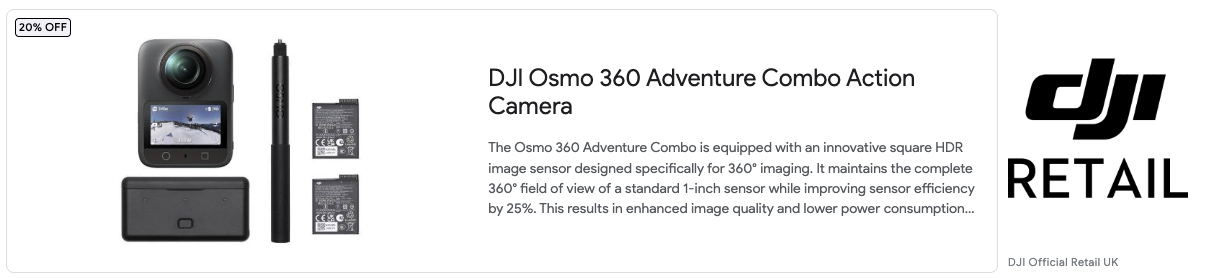
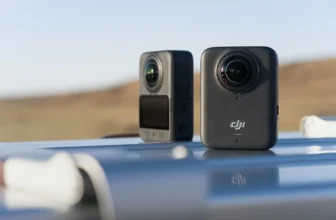
For motovloggers looking to capture more than a conventional forward-facing view, the DJI Osmo 360 II represents an exciting development in motorcycle filmmaking.
Launched in September 2026, DJI’s second-generation 360-degree action camera offers 8K recording at 60 frames per second, allowing riders to capture their surroundings in impressive detail while retaining the flexibility to choose camera angles during editing.
Unlike traditional action cameras, which record a fixed viewpoint, the Osmo 360 II captures everything around the camera. This allows creators to produce forward-facing footage, rider-focused sequences and dramatic third-person perspectives from a single recording.
Its standout features include:
-
8K/60fps 360-degree recording, particularly useful for fast-moving motorcycle footage.
-
Replaceable lenses, reducing the inconvenience of damage to exposed 360-degree optics.
-
105GB of built-in storage, providing additional recording capacity.
-
Spotlight Follow, allowing subjects to remain centred without extensive manual reframing.
-
DJI OsmoAudio connectivity, supporting compatible wireless microphones.
-
AI SuperNight 2.0, designed to improve low-light recording.
These capabilities make the Osmo 360 II particularly interesting for motorcycle touring, scenic rides, creative walk-arounds and motovlogging content that benefits from multiple viewpoints.
There are compromises. High-resolution 360-degree footage requires more storage and editing resources, while the exposed lenses demand careful handling. Helmet mounting may also be less practical than with a smaller conventional action camera.
Nevertheless, the combination of high-resolution panoramic recording, replaceable lenses and flexible editing makes it our preferred choice for creative 360-degree motorcycle footage.
MotoVlogger’s verdict: The DJI Osmo 360 II is our recommendation for riders wanting to capture immersive 360-degree action, cinematic touring footage and multiple perspectives from a single camera.
Updated MotoVlogger recommendations
| Category | Recommended camera |
|---|---|
| Best everyday motovlogging camera | DJI Osmo Action 6 |
| Best traditional action camera | GoPro HERO13 Black |
| Best for Bluetooth helmet audio | Insta360 Ace Pro 2 |
| Best for 360° action motovlogging | DJI Osmo 360 II |
Updated article verdict
For 2027, DJI makes a particularly compelling case for motovloggers with two complementary cameras.
The DJI Osmo Action 6 is our preferred choice for conventional helmet-mounted filming and everyday riding commentary, while the DJI Osmo 360 II takes our recommendation for creative 360-degree action recording.
Together, they demonstrate how motovlogging is evolving beyond a single fixed camera angle, giving riders greater freedom to capture their journeys and tell their stories.
The Osmo 360 II is especially appealing to creators who want to produce more cinematic motorcycle videos without constantly repositioning their camera.
This recommendation is based on published specifications and independent reviews, rather than MotoVlogger’s own hands-on testing.
GoPro vs DJI vs Insta360: Specifications Compared
The following table compares three conventional action cameras, rather than mixing standard cameras with dedicated 360-degree models.
| Feature | GoPro HERO13 Black | DJI Osmo Action 6 | Insta360 Ace Pro 2 |
|---|---|---|---|
| Maximum video | 5.3K/60fps | 8K/30fps | 8K/30fps |
| Sensor | 1/1.9-inch | 1/1.1-inch | 1/1.3-inch |
| Stabilisation | HyperSmooth | RockSteady | FlowState |
| Helmet audio | External mic options | Compatible DJI wireless mics | Selected Bluetooth headsets |
| Distinctive feature | HB-Series lenses | Variable aperture | Flip-up screen |
| Main appeal | Versatility | Everyday recording | Creative flexibility |
Published manufacturer specifications; selected recording modes may limit stabilisation or other features.

DJI Osmo Helmet Chin Mount Clip
£19.00
Amazon.co.uk
DJI Osmo Helmet Chin Mount Clip
Image Stabilisation: Which Camera Handles Motorcycle Vibration Best?
Motorcycle filming presents a particularly demanding environment for electronic image stabilisation.
Engine vibration, uneven road surfaces, helmet movement and rapid changes in direction can all affect the final footage.
GoPro’s HyperSmooth, DJI’s RockSteady and Insta360’s FlowState systems are designed to compensate for unwanted camera movement.
All three can produce smooth footage under suitable conditions, but stabilisation performance depends on recording settings, lighting, mounting position and vibration frequency.
A camera mounted securely to a helmet may produce considerably better results than the same camera attached to a vibrating motorcycle component.
It is also worth remembering that electronic stabilisation often crops the image. This can affect how much of the motorcycle, road and surrounding scenery remains visible.
For everyday motovlogging, stabilisation quality at 4K is generally more relevant than maximum-resolution recording without full stabilisation support.
Without controlled side-by-side testing, there is no reliable basis for declaring one of these systems the outright winner in every riding situation.
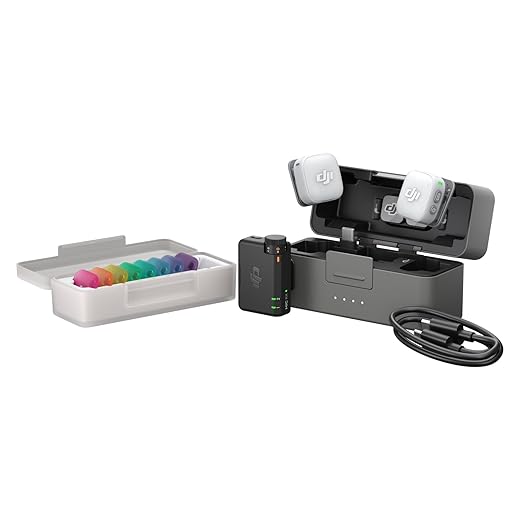
DJI Mic Mini 2 (2 TX + 1 Standard RX + Charging Case)
£89.00
Amazon.co.uk
DJI Mic Mini 2 (2 TX + 1 Standard RX + Charging Case)
Audio Recording: The Deciding Factor for Many Motovloggers
For riders who regularly speak while riding, audio recording may be more important than minor differences in picture quality.
GoPro provides external microphone options, but the required connections and accessories need careful consideration.
DJI’s direct wireless microphone integration offers a relatively streamlined approach when using compatible products.
Insta360’s support for selected motorcycle Bluetooth headsets is particularly interesting for riders already using a Sena or Cardo communication system.
However, none of these approaches guarantees clear speech at motorway speeds.
A microphone positioned correctly inside the helmet, protected from wind turbulence and tested before filming, remains essential.
For anyone purchasing their first motovlogging camera, we would recommend researching the complete audio setup before committing to a particular model.
Battery Life, Weather Protection and Practicality
Motorcycle journeys rarely follow a predictable filming schedule.
A camera may be exposed to rain, cold temperatures, direct sunlight and long periods of continuous recording.
All three manufacturers offer cameras designed for outdoor use, but battery endurance and recording reliability depend on the selected settings and conditions.
Higher resolutions and frame rates typically increase power consumption. Cold weather can reduce battery performance, while high ambient temperatures and restricted airflow can affect heat management.
For touring, spare batteries and a suitable charging arrangement are sensible investments.
Ease of operation matters too.
Large controls, quick-release mounts, clear recording indicators and straightforward menus can make a considerable difference when preparing to film at the roadside.
Never attempt to change complicated camera settings while riding. Stop somewhere safe before adjusting equipment.
Which Camera Is Best for Different Types of Motovlogging?
DJI Osmo Action 6
Best starting point for everyday motovlogging: DJI Osmo Action 6
Its microphone integration, stabilisation, sensor and internal storage make it a strong all-round option for riders recording regular commentary and road footage.
GoPro HERO13 Black
Best for traditional action-camera versatility: GoPro HERO13 Black
Particularly suitable for riders who want extensive mounting options, established accessories and flexible conventional filming.
Insta360 Ace Pro 2 Motorcycle Bundle
Best for compatible Bluetooth helmet audio: Insta360 Ace Pro 2
An appealing option for riders with supported intercom systems who also want high-resolution video and a flip-up screen.

Insta360 X5
Ideal for capturing multiple angles from one recording, cinematic touring footage and third-person motorcycle sequences.
These are editorial recommendations based on published capabilities and motovlogging workflows, rather than the results of a controlled hands-on comparison.
DJI Osmo 360 II Standard Combo
£509.00
Amazon.co.uk
DJI Osmo 360 II Standard Combo
Best for 360° Action Motovlogging: DJI Osmo 360 II
Is 8K Really Necessary for Motovlogging?
One of the biggest marketing attractions of modern action cameras is increasingly high video resolution.
However, most motovloggers do not need to record every journey in 8K.
For YouTube videos, 4K footage can deliver excellent image quality while keeping storage requirements, editing demands and upload times manageable.
Higher resolutions can be useful when cropping footage, producing multiple aspect ratios or extracting detailed images from recordings.
However, they also introduce practical disadvantages.
A 90-minute motorcycle journey recorded at a high bitrate can consume substantial storage space, and editing demanding footage may require a powerful computer.
For most riders, 4K at 30fps or 60fps remains a sensible everyday choice.
The Importance of the Complete Camera Setup
Choosing between GoPro, DJI and Insta360 should not be considered in isolation.
A successful motovlogging setup includes a secure mounting arrangement, microphone, storage, spare power and a reliable editing workflow.
A rider who spends their entire budget on a flagship camera but neglects audio recording may struggle to produce enjoyable videos.
Conversely, a slightly older camera paired with a carefully positioned microphone and effective editing can produce excellent results.
Before purchasing, consider the total cost of ownership, including additional batteries, mounting accessories, microphone adapters and replacement parts.
It is also worth checking whether existing equipment can be reused when upgrading.
MotoVlogger Verdict: Which Would We Choose for 2027?
The competition between GoPro, DJI and Insta360 is closer and more interesting than ever.
GoPro remains a strong choice for riders who value conventional action-camera filming, extensive accessories and a familiar recording experience. Its newer MISSION range also offers additional options for creators seeking higher-end specifications.
DJI’s Osmo Action 6 makes a particularly persuasive case for everyday motovlogging. Its combination of image quality, stabilisation, audio connectivity and practical features is well suited to riders who want to concentrate on the journey rather than managing complicated equipment.
Insta360 offers a different proposition. The Ace Pro 2 is a capable conventional action camera, while the company’s 360-degree models provide creative possibilities that standard cameras cannot easily replicate.
For 2027, DJI makes a particularly compelling case for motovloggers with two complementary cameras.
The DJI Osmo Action 6 is our preferred choice for conventional helmet-mounted filming and everyday riding commentary, while the DJI Osmo 360 II takes our recommendation for creative 360-degree action recording.
Together, they demonstrate how motovlogging is evolving beyond a single fixed camera angle, giving riders greater freedom to capture their journeys and tell their stories.
The Osmo 360 II is especially appealing to creators who want to produce more cinematic motorcycle videos without constantly repositioning their camera.
This recommendation is based on published specifications and independent reviews, rather than MotoVlogger’s own hands-on testing.
However, riders who already own compatible Sena or Cardo equipment should investigate the Insta360 Ace Pro 2 before making a decision, while those prioritising unusual camera angles may find a dedicated Insta360 360-degree camera more rewarding.
Ultimately, the best action camera is the one that fits your motorcycle, your filming style and your budget.
The technology will continue to evolve throughout 2027, but the most important ingredient in a successful motovlog remains unchanged: an interesting journey, a compelling story and a rider who enjoys sharing the experience.